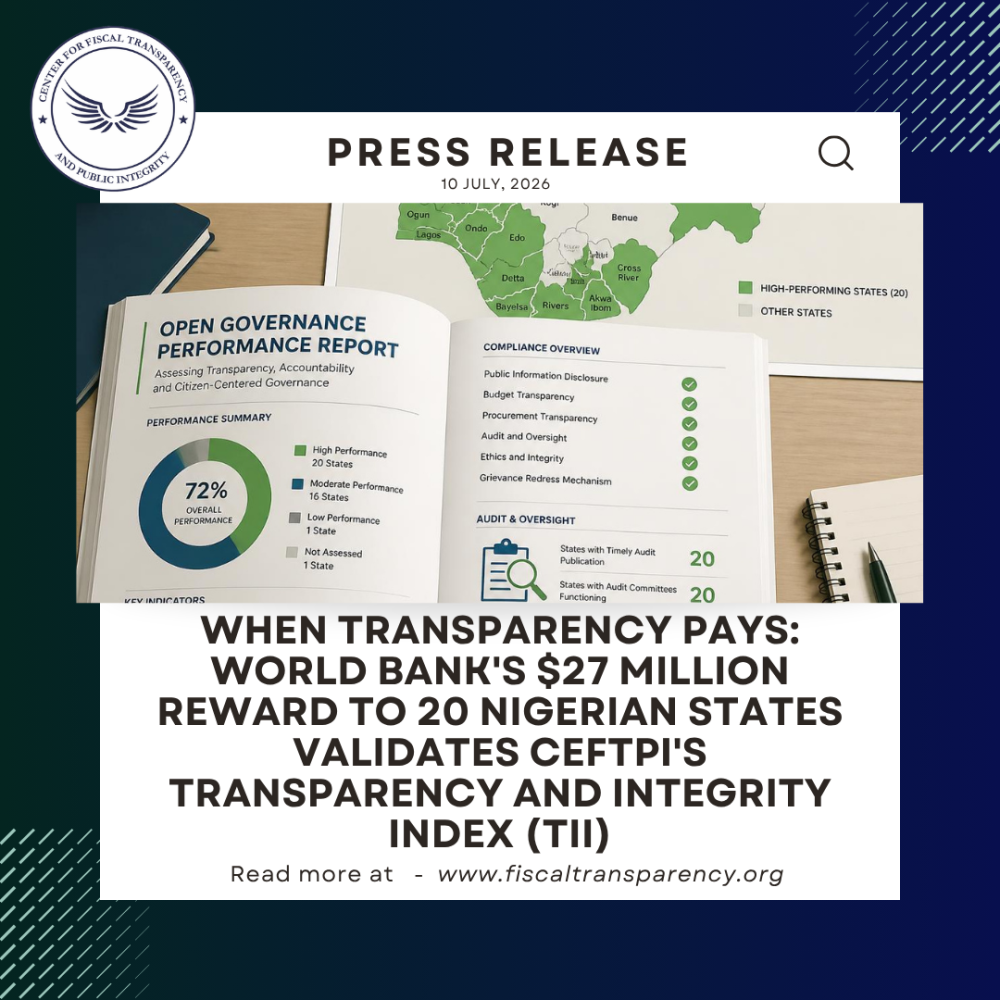
The Center for Fiscal Transparency and Public Integrity (CeFTPI) states that the World Bank’s decision to award $27 million in performance-based grants to twenty (20) Nigerian states under the Human Capital Opportunities for Prosperity and Equity Governance (HOPE-GOV) Programme, provides independent validation of the principles that have informed Center’s Transparency and Integrity Index (TII) since its inception in 2021.
The announcement demonstrates an important shift in public governance. Transparency is no longer merely a statutory obligation or a governance aspiration; it is increasingly becoming a measurable requirement for accessing development finance. Governments that publish credible information, strengthen public financial management systems and satisfy independently verified governance standards are increasingly being rewarded through performance-based financing mechanisms.
The grants were announced on 30 June 2026 during the retreat of Commissioners, Permanent Secretaries and Directors of Budget and Planning in Abuja. According to the National Coordinator of HOPE-GOV, Dr Assad Hassan, the beneficiary states achieved the programme’s “Year Zero” Disbursement-Linked Results across basic education, primary healthcare and public financial management. These results were independently verified before the grants were approved under the World Bank-supported programme.
Four states namely: Bayelsa, Borno, Kano and Yobe met the verification standard across all four Year Zero result areas, with Kebbi qualifying in three. Fourteen additional states: Abia, Adamawa, Delta, Edo, Ekiti, Enugu, Gombe, Imo, Jigawa, Kogi, Nasarawa, Ondo, Plateau and Taraba earned grants in at least one category. Sixteen states received no allocation after failing to satisfy one or more of the programme’s verification requirements, including compliance with prescribed disclosure standards.
CeFTPI observes that one of the defining features of the HOPE-GOV assessment is its emphasis on verifiable public disclosure. States were required not only to implement reforms but also to demonstrate those reforms through accessible and verifiable information. This reflects the same principle that has underpinned the Transparency and Integrity Index for five consecutive years: information that is not publicly available cannot meaningfully support transparency, accountability or public oversight.
The Center notes that the World Bank did not reward policy intentions or institutional promises. It rewarded measurable governance outcomes supported by independently verifiable evidence. This distinction is significant because it reinforces the growing expectation among development partners that transparency should be demonstrated through institutional practice rather than policy declarations.
CeFTPI’s analysis identifies substantial alignment between the HOPE-GOV assessment framework and the five equally weighted indicators of the Transparency and Integrity Index: Fiscal Transparency, Open Procurement, Human Resources and Inclusion, Control of Corruption, and Citizens’ Engagement. These indicators are assessed against the Constitution of the Federal Republic of Nigeria, the Freedom of Information Act 2011, the Fiscal Responsibility Act 2007, the Public Procurement Act 2007, Executive Order 001 of 2017, and Nigeria’s international commitments under the United Nations Convention against Corruption and Sustainable Development Goal 16.
The Center further observes that the programme’s recognition of reforms relating to local government budgeting reinforces the importance of strengthening accountability beyond state governments. In particular, HOPE-GOV’s support for harmonized local government budget guidelines reflects principles already advanced through CeFTPI’s Nigerian Local Government Integrity Index (NLGII) and the Accountability and Corruption Prevention Programme for Local Governments (ACCP-LG), both of which seek to improve transparency and accountability across Nigeria’s 774 local government areas.
More broadly, the HOPE-GOV disbursement illustrates the continued evolution of development financing. International development partners are increasingly moving away from financing based primarily on commitments and toward financing linked to independently verified governance performance. This approach rewards governments that institutionalize transparency, strengthen accountability systems and demonstrate measurable reform outcomes.
For states that did not qualify, the Center maintains the same position it has consistently advanced through successive editions of the Transparency and Integrity Index. The outcome should not be viewed as a condemnation but as an administrative diagnosis. The identified shortcomings relate primarily to institutional processes, public disclosure practices and inter-agency coordination, all of which can be addressed through deliberate reforms.
The Center therefore encourages all thirty-six states to regard the forthcoming 2026 Transparency and Integrity Index, scheduled for release on 28 September 2026, the International Day for Universal Access to Information, as an opportunity to strengthen institutional transparency and improve preparedness for future performance-based financing opportunities.
RECOMMENDATIONS
The Center calls on the State Governments to:
- Institutionalize proactive disclosure by ensuring that budgets, citizens’ budgets, budget implementation reports, procurement records, audit reports, debt profiles and other statutory governance documents are consistently published and maintained on official government websites.
- Strengthen institutional coordination through dedicated transparency and results-delivery mechanisms involving ministries responsible for finance, budget and planning, procurement, education, health, audit, debt management and information technology.
- Integrate local government transparency into broader state governance reforms by adopting accountability mechanisms consistent with the Nigerian Local Government Integrity Index and the Accountability and Corruption Prevention Programme for Local Governments.
- Improve the accessibility, quality and usability of public information to enable citizens, researchers, civil society organizations, journalists and development partners to independently verify government performance.
- Encourage active citizen participation by promoting the use of publicly available information as a tool for oversight, accountability and evidence-based public engagement.
The Center also encourages citizens, civil society organizations and the media to make greater use of the Transparency and Integrity Index in assessing whether state governments are complying with statutory transparency obligations and to demand corrective action where critical public information remains unavailable.
OUR COMMITMENT
The Center for Fiscal Transparency and Public Integrity (CeFTPI) is a non-partisan, non-governmental organization committed to advancing transparency, accountability and integrity in public institutions. Since 2021, the Center has published the Transparency and Integrity Index (TII), an annual evidence-based assessment of more than 500 federal and subnational public institutions, including all thirty-six state governments. CeFTPI also develops the Nigerian Local Government Integrity Index (NLGII) and the Local Government Accountability Framework (LGAF) to strengthen governance, improve institutional performance and promote public accountability across Nigeria.
Signed:
Umar Yakubu, Ph.D
Executive Director