
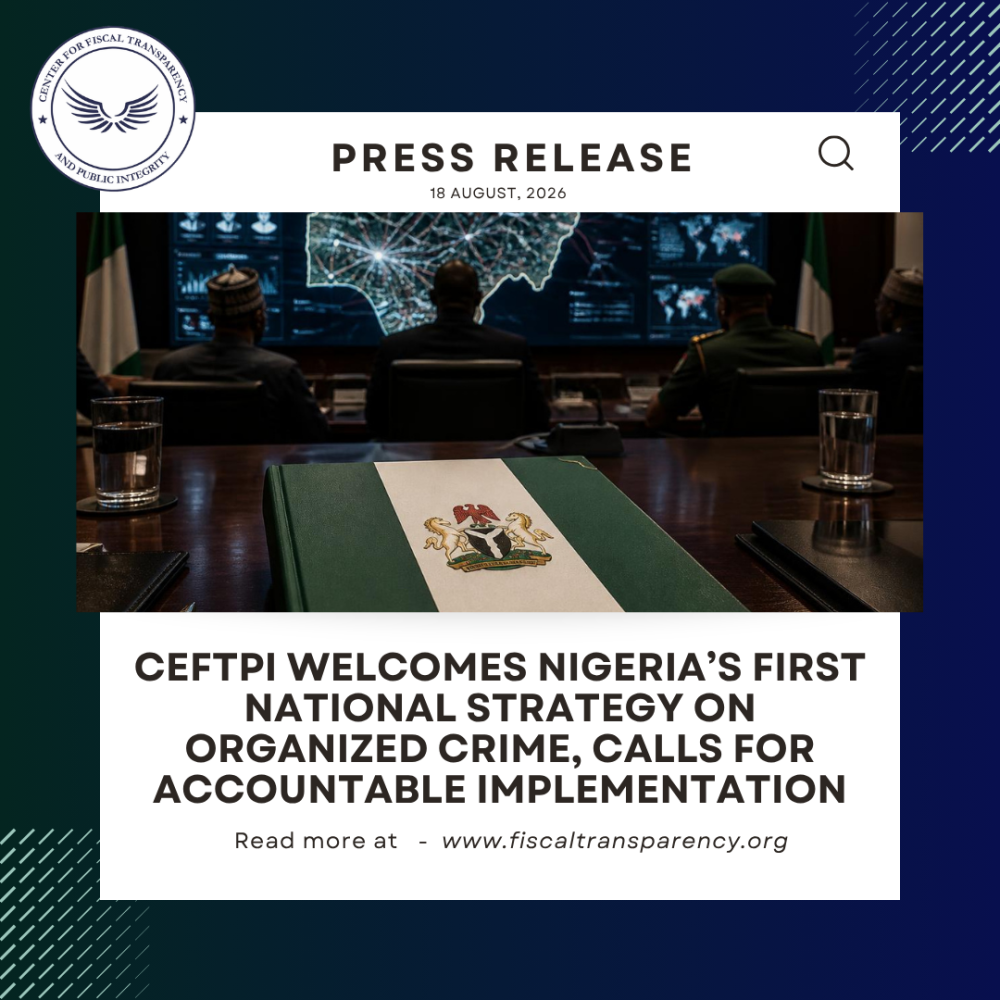
The Center for Fiscal Transparency and Public Integrity (CeFTPI) welcomes the launch of Nigeria’s first National Strategy for Combating Organized Crime (2027–2031), describing it as an important step towards strengthening Nigeria’s coordinated response to the growing threat of organized crime.
The Strategy, launched on 17 August 2026, provides a national framework for addressing organized criminal activities through a coordinated approach built around Prevention, Pursuit, Protection and Promotion.
For CeFTPI, the development marks an important progression in Nigeria’s organized crime response and aligns with the Center’s sustained engagement in this area.
In 2023, CeFTPI convened the International Symposium on Countering Organized Crime in Africa, which brought together key stakeholders to examine emerging organized crime threats and develop practical policy responses. The Symposium produced 16 policy recommendations aimed at strengthening institutional coordination, financial intelligence, law enforcement, accountability and resilience.
In 2026, through its Organized Crime Resilience Initiative (OCRI) Policy Brief, CeFTPI assessed progress against these recommendations, highlighting implementation gaps and persistent institutional challenges. The findings reinforced a critical lesson: the effectiveness of policy frameworks ultimately depends on sustained and measurable implementation.
Against this background, CeFTPI considers the new National Strategy a significant opportunity to move from fragmented responses towards a more coordinated and accountable national approach.
The Center therefore calls for the Strategy to be supported by clear implementation timelines, measurable performance indicators, adequate resourcing, transparent reporting and independent monitoring. Regular assessment of progress will be essential to ensuring that commitments translate into tangible improvements in Nigeria’s capacity to prevent and disrupt organized criminal networks.
CeFTPI further emphasizes that combating organized crime requires more than enforcement. It requires stronger institutions, effective inter-agency coordination, financial transparency, accountable security spending and resilient communities.
As implementation of the 2027–2031 Strategy begins, CeFTPI remains committed to contributing through research, policy engagement and independent monitoring to strengthen Nigeria’s resilience against organized crime.
Signed:
Umar Yakubu, Ph.D
Executive Director