
Transparency and Integrity Index
The Transparency and Integrity Index (TII) is an annual, evidence-based assessment of proactive disclosure and integrity systems in Nigeria's public institutions. It has been published every year since 2021.
What the Index Measures
The Index asks one practical question of each institution: is the information that the law requires it to publish actually available to the public? Assessors examine the websites and portals of public institutions for specific documents and mechanisms, and score what they find.
The 2026 edition assessed institutions in five areas, each carrying 20 percent of the total score:
- Fiscal Transparency. Budgets, expenditure reports, audit reports and related financial disclosures.
- Open Procurement and Contracting. Tender advertisements, procurement plans and records of contracts awarded.
- Human Resources and Inclusion. Information on personnel, recruitment, promotion and inclusion.
- Control of Corruption. Anti-corruption policies and the institutional mechanisms that support them.
- Citizens' Engagement. Channels for communication, feedback and Freedom of Information requests.
Why It Was Developed
Nigerian law already requires extensive disclosure by public institutions. The Freedom of Information Act 2011 mandates proactive publication; the Public Procurement Act 2007 and the Fiscal Responsibility Act 2007 set further duties. What was missing was a regular, comparable measure of compliance. The Index supplies one, so that institutions can see where they stand and citizens can see what is being withheld.
The Index is designed to guide reform. It is not intended to single out individual agencies.
How Institutions Are Assessed
Each of the five areas is divided into sub-variables. The points available for an area are divided equally among its sub-variables, the points obtained are summed, and the result is expressed as a score out of 100. Institutions are then placed in performance bands.
The sub-variables and scoring criteria for each edition are set out in that year's methodology handbook, which is presented to institutions before the assessment period so that they can prepare. The areas assessed have been revised between editions, so scores from different years should be compared with that in mind.
Institutional Partnership
The Index is conducted in partnership with the Bureau of Public Service Reforms (BPSR). The 2025 and 2026 methodology handbooks and results were presented jointly by the Center and the Bureau in Abuja.
Record of Activity
- 28 September 2026Results of the 2026 edition presented with the Bureau of Public Service Reforms in Abuja, on the International Day for Universal Access to Information. Read the Report
- 3 June 20262026 methodology presented to stakeholders with the Bureau of Public Service Reforms. Read the Report
- 30 September 2025Fifth edition unveiled: 517 federal institutions and 36 states assessed. Read the Report
- 28 September 2021First edition presented to the public at the Shehu Musa Yar'Adua Centre, Abuja.
State Governments, 2024 to 2026
Overall Score by State, 2026
Percent of the total obtainable score. Average of the 36 states: . Change shown against the previous edition.
Source: state ranking tables in the published Transparency and Integrity Index reports for 2024, 2025 and 2026. The areas assessed were revised between editions, so year-on-year changes reflect both performance and method. The 2024 report also lists the Federal Capital Territory, at 2.58 percent, which is not shown here. State tables for 2021 to 2023 are in the reports for those years.
Highest-Scoring Federal Institutions, 2026
Four of 518 institutions reached the Excellent band of 70 percent and above. Eight scored above 50 percent.
Source: TII 2026 report, general ranking of ministries, departments, agencies and government-owned enterprises.
Average Score by Sector, 2026
Twelve sectors of federal institutions.
Source: TII 2026 report, sectoral ranking.
The full ranking of all 518 federal institutions, with scores in each of the five areas, is published in the 2026 report. Four institutions scored zero.
Reports and Methodology Handbooks, 2021 to 2026
| Edition | Coverage | Documents |
|---|---|---|
| 2026 | 518 federal institutions and 36 states. Five equally weighted areas. | Report · Methodology |
| 2025 | 517 federal institutions and 36 states. | Report · Methodology |
| 2024 | Report · Methodology | |
| 2023 | Report | |
| 2022 | Report · Methodology | |
| 2021 | First edition, presented 28 September 2021. | Report · Federal Results · State and Local Results |
Latest on This Project
 Press release28 September 2026
2026 Transparency and Integrity Index: Only Three States Score Above 45% as Public Sector Disclosure Remains Low
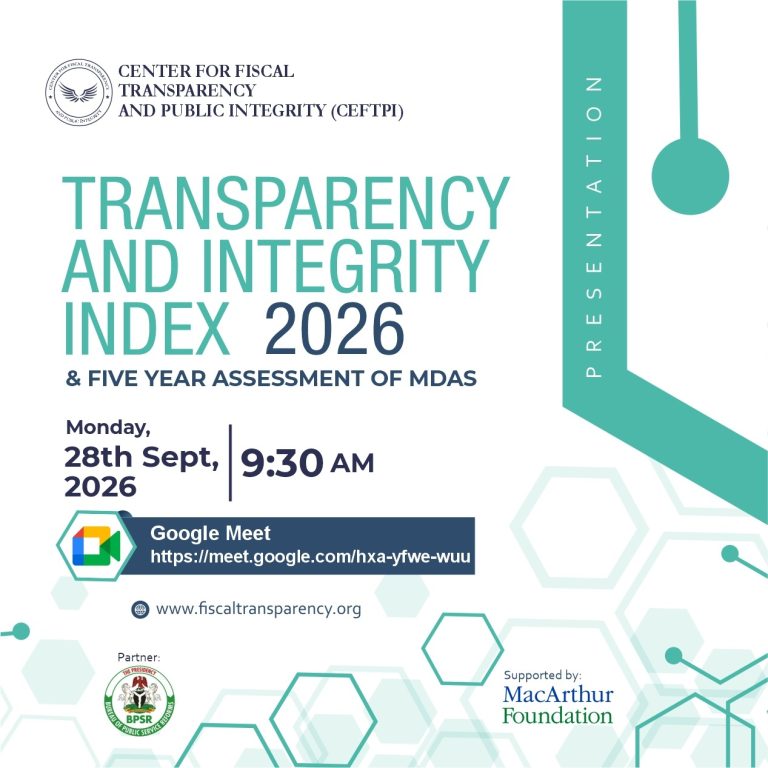 News25 September 2026
Presentation of Transparency and Integrity Index (TII) 2026
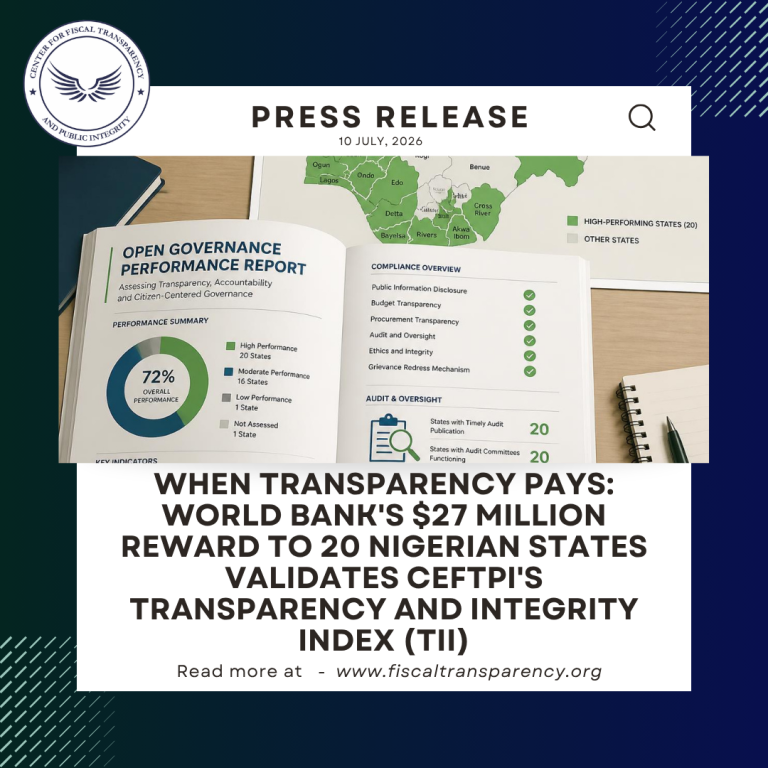 Press release10 July 2026
When Transparency Pays: World Bank’s $27 Million Reward to 20 Nigerian States Validates CeFTPI’s Transparency and Integrity Index (TII)
Questions, Corrections and Engagement
To ask about this work, to report an error or to discuss collaboration, write to mail@fiscaltransparency.org.