
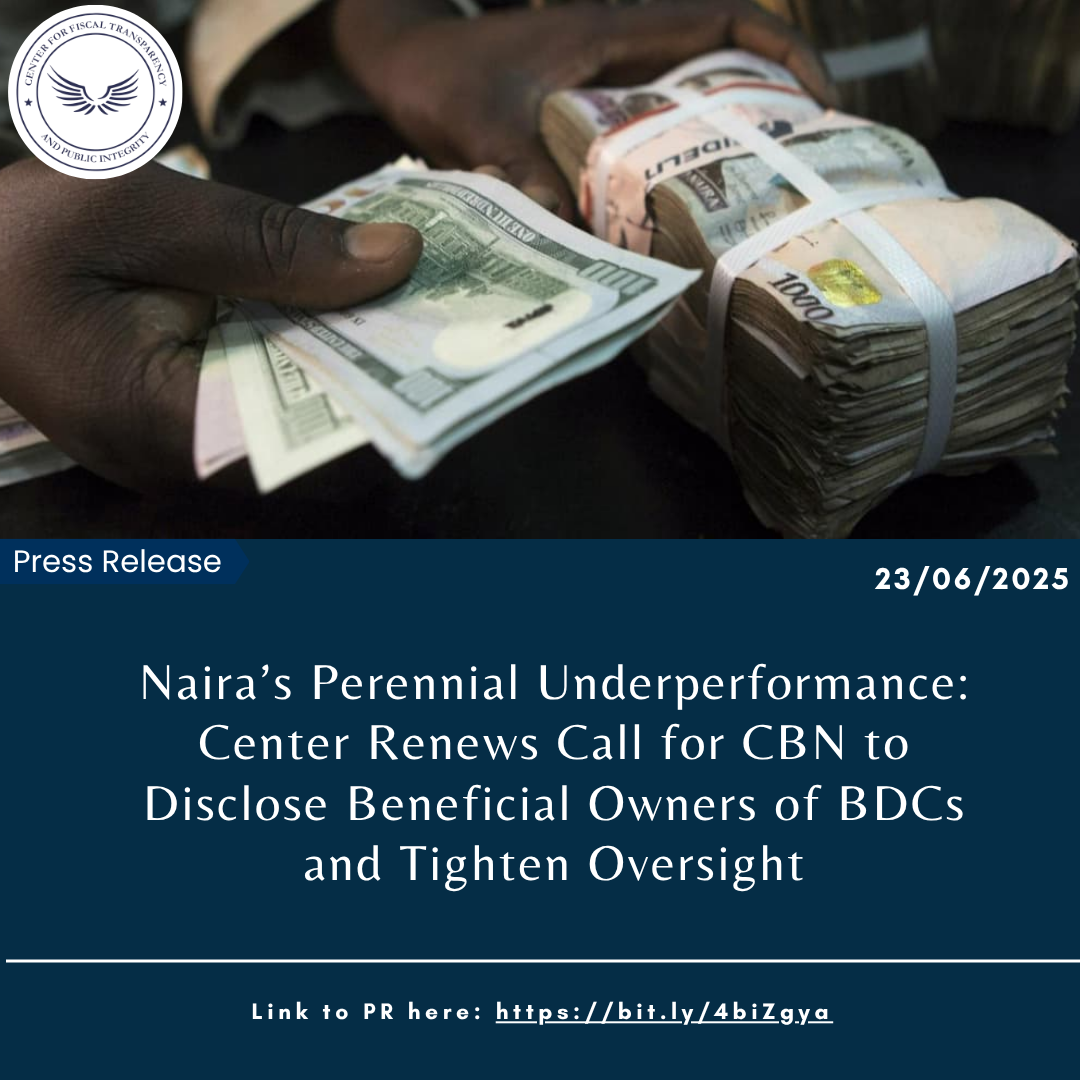
The Center for Fiscal Transparency and Public Integrity (CeFTPI) is concerned about the continued underperformance of the naira, despite several monetary policy reforms, including the floating of the currency and interventions by the Central Bank of Nigeria (CBN). The persistent weakness of the naira against the dollar has continued to fuel inflation and deepen economic hardship for ordinary Nigerians, raising questions about the transparency and effectiveness of key players in the foreign exchange market, particularly Bureau De Change (BDC) operators and deposit money banks.
The Center once again calls on the CBN to publicly disclose the beneficial owners of all licensed BDCs in Nigeria. The lack of transparency around these entities creates room for regulatory abuse, political patronage, and manipulation of the forex market. Many BDCs, originally intended to facilitate access to retail foreign exchange, have morphed into vehicles for round-tripping, arbitrage, and illicit financial flows. These practices not only distort the forex ecosystem but also undermine public trust in the CBN’s capacity to stabilize the naira and promote an inclusive economic recovery.
There is a growing concern that some deposit money banks, which serve as intermediaries for these BDCs, are complicit in enabling round-tripping and speculative trading activities that further weaken the naira and sabotage policy interventions aimed at price stability. It is therefore imperative for the CBN to strengthen its oversight mechanisms and ensure that access to foreign exchange is governed by fairness, merit, and traceable transactions, rather than backdoor dealings that benefit a few at the expense of millions.
The Center believe that a sound monetary policy cannot thrive in the absence of transparency. The continued weakening of the naira, despite all the economic adjustments, suggests that the country is yet to tackle the real problem: an opaque and manipulated forex market. The CBN must come clean on who controls the BDCs and clamp down on the banks that enable round-tripping.
The Center emphasizes that until the issue of ownership transparency and regulatory enforcement is addressed, Nigeria’s forex market will remain vulnerable to exploitation, and efforts to stabilize the economy will remain largely cosmetic. In order to restore confidence in the naira, bold fiscal and institutional reforms that prioritize accountability and openness must go hand-in-hand.
Signed:
Victor Agi
Head, Public Relations