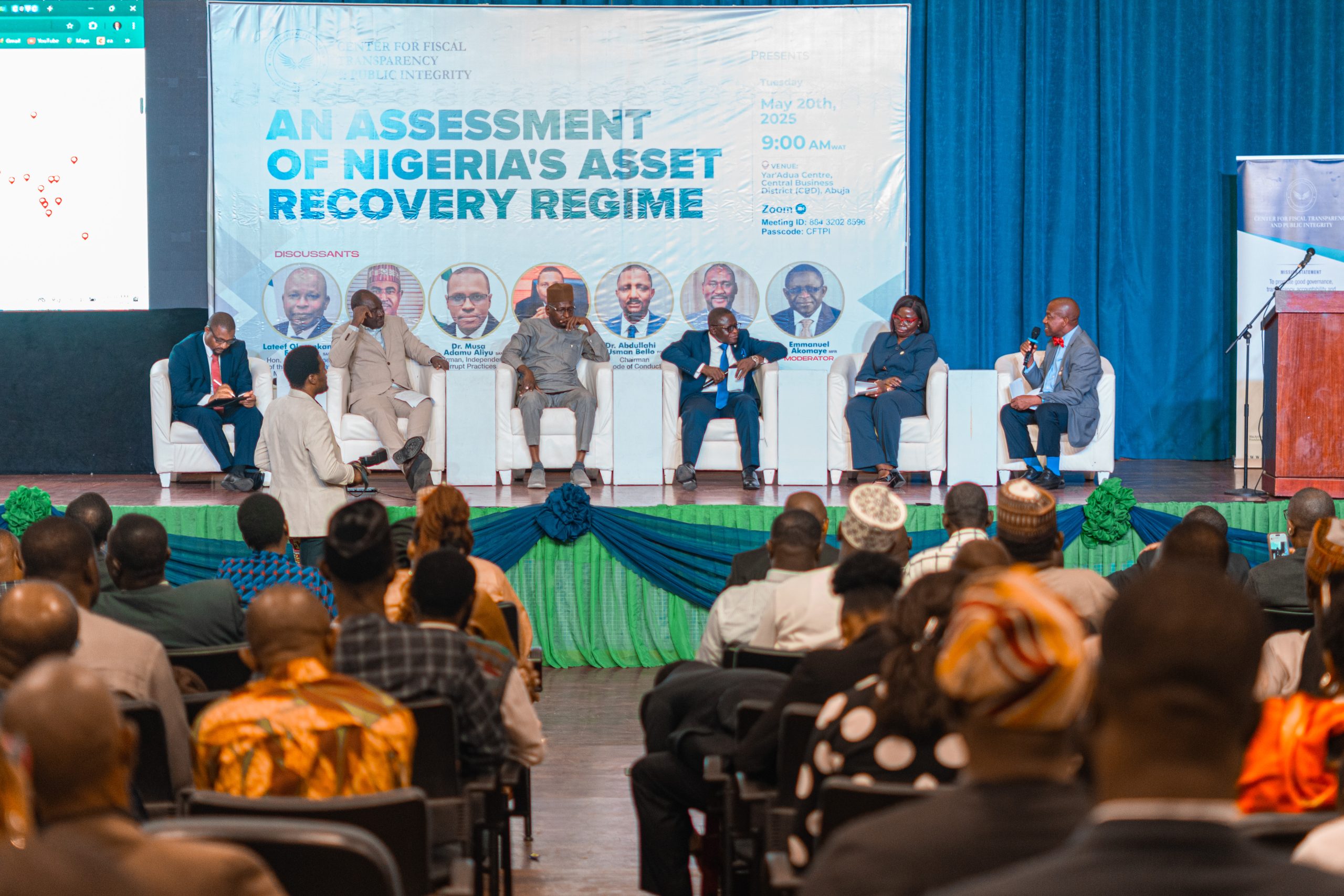
In a move to deepen transparency and accountability in Nigeria’s anti-corruption efforts, the Center for Fiscal Transparency and Public Integrity (CFTPI), with support from the Inter-Governmental Action Group against Money Laundering in West Africa (GIABA), yesterday launched a civil society Asset Recovery Database. The launch took place during a high-level advocacy event held in Abuja, aimed at assessing Nigeria’s asset recovery regime over the years.
The event, themed “An Assessment of Nigeria’s Asset Recovery Regime,” convened top anti-corruption actors, including Dr. Musa Adamu Aliyu, SAN, Chairman of the Independent Corrupt Practices and Other Related Offences Commission (ICPC), Dr. Abudullahi Bello, the Chairman of the Code of Conduct Bureau, Gbolahan Latona, fsi, the Director of Proceeds of Crime Directorate, Economic and Financial Crimes Commission (EFCC) representatives of the Ministry of Justice, the National Drug Law Enforcement Agency (NDLEA), GIABA, civil society organizations, and members of the press.
The newly launched Asset Recovery Database, available at www.fiscaltransparency.org/assetdatabase/database/dashboard.php, serves as a centralized, publicly accessible repository of data on assets recovered by the Nigerian government from corrupt practices, both domestically and abroad.
In his welcome address, Dr. Umar Yakubu, Executive Director of CFTPI, emphasized that the fight for asset recovery is not just a legal necessity but a national development imperative. “Illicitly acquired assets, whether hidden within our borders or stashed abroad, are stolen opportunities: resources meant for schools, hospitals, infrastructure, and social welfare,” he said. “Their recovery is about restoring the public’s trust and reclaiming a future for all Nigerians.”
Tim Melaye, representing GIABA’s Director-General Edwin W. Harris Jr., highlighted the scale of the problem, citing a UN Economic Commission for Africa report estimating that Africa loses $88–94 billion annually to illicit financial flows. “Where are these monies? How do we recover them, and how do we ensure they aren’t re-looted?” Melaye asked, urging stakeholders to strengthen regional efforts. He noted GIABA’s commitment, including $300,000 disbursed in 2025 to 12 civil society organizations across ECOWAS to boost asset recovery advocacy.
“Until we take the profit out of crime, criminals will continue to thrive,” he warned. “This launch represents a call to all stakeholders to step up efforts to track, recover, and transparently manage illicit assets,” he added.
Also speaking at the event, the Chairman of the Independent Corrupt Practices and Other Related Offences Commission (ICPC), Dr. Musa Adamu Aliyu, SAN, commended the Center for its commitment to transparency and innovation. He described the Asset Recovery Database as a valuable tool that will enhance public confidence in the nation’s anti-corruption framework. “Asset recovery must go beyond seizures and repatriations; we must ensure the public knows where these assets are going and how they are being utilized,” he stated.
Dr. Aliyu further stressed the need for synergy among anti-corruption agencies, civil society, and international partners to create a more unified and impactful asset recovery regime.
The event also featured a review of the Proceeds of Crime Act 2022, and a panel discussion on Nigeria’s asset recovery regime moderated by the Emmanuel Akomaye, MFR. The session underscored both progress and persistent hurdles. Discussions focused on the need to emphasize and prioritize recovery alongside prosecutions, coordination and the involvement of the public to drive accountability.
The Database as a Tool for Change, But Not a Silver Bullet
While Nigeria has made gains in the area of asset recovery, significant challenges remain, particularly in the areas of inter-agency coordination, public disclosure, and effective use of recovered funds. The Asset Recovery Database is a timely response to these gaps, providing a verifiable and interactive resource for government institutions, researchers, the media, and the public.
Beyond merely listing figures and sources, the database introduces a new level of accountability, offering transparency on what has been recovered, from where, by whom, and, critically, what it is used for. This aligns with the World Bank Group and the United Nations Office on Drugs and Crime’s (UNODC) Stolen Asset Recovery (StAR) initiative which document assets from country of origin and destination. The database clearly shows how assets are taken away from Africa, and signals the need for concerted steps to be taken to recover these assets for the development of the continent.
But as stakeholders noted during the event, technology alone is not enough. The success of this initiative will depend on sustained political will, agency cooperation, legal reforms, and continued civic engagement. Civil society and media actors were repeatedly identified as key to ensuring that the public remains informed and that the management of recovered assets aligns with national development goals.
“Civil society is the backbone of advocacy and change,” said Mr. Melaye. “CSOs must raise their voices until all our stolen money is returned—and used for the benefit of the people.”
The launch of the Asset Recovery Database marks a new step in Nigeria’s anti-corruption efforts. It sends a strong signal that transparency is not negotiable, and that public institutions must work collaboratively to return stolen wealth to its rightful owners, the Nigerian people.
As the country continues to face fiscal challenges and growing demands for accountability, initiatives like this database are not only timely but essential. They provide a measurable, public-facing tool for tracking progress, exposing lapses, and building trust between citizens and the state.